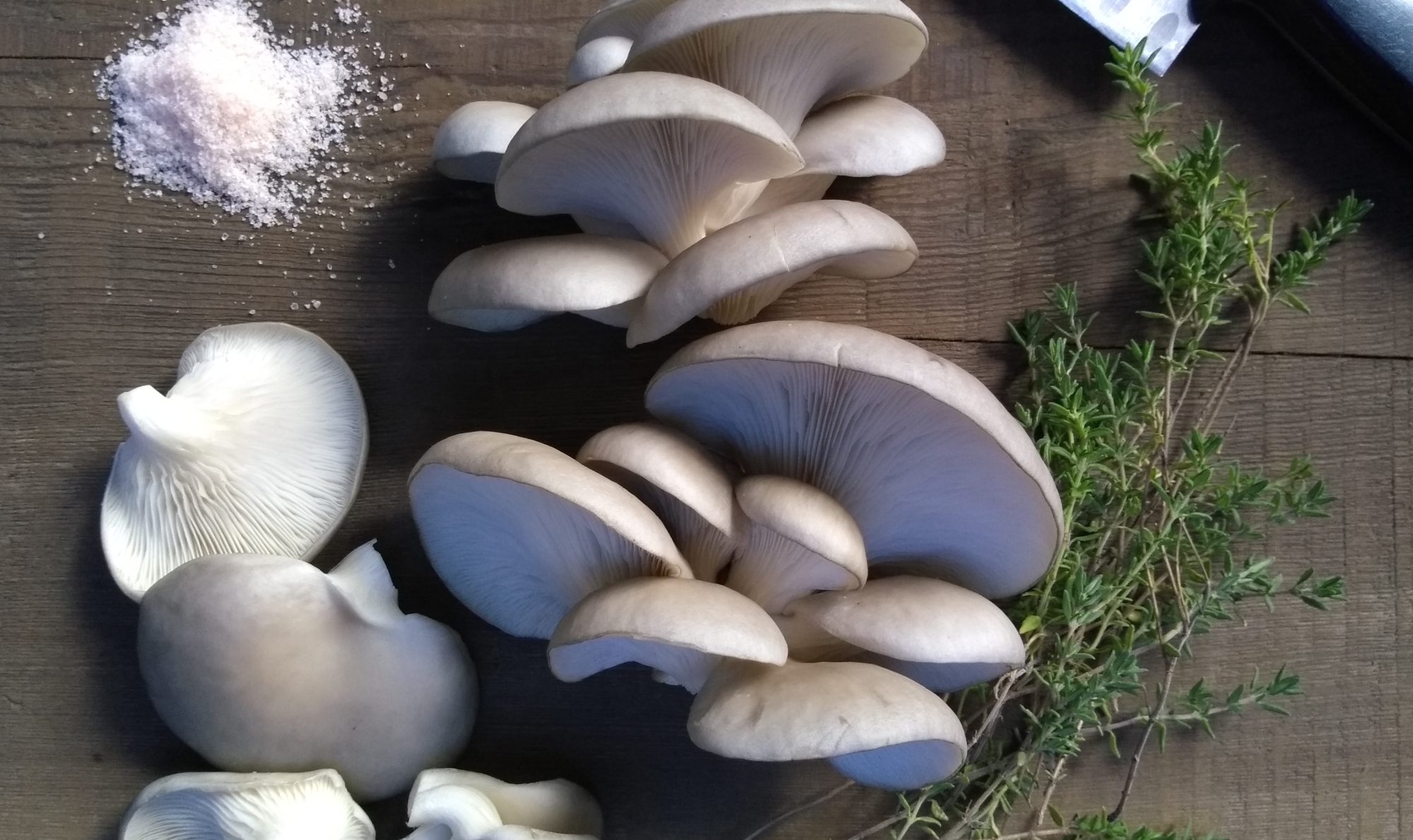
Our mushrooms really speak for themselves, but if you want the story, here it is!

We operate a small scale, organic mushroom farm on the coast just north of Fort Bragg, CA. We started our farm in Boonville in 2018, but had to relocate in 2024. At its peak, The Forest People grew over a 100 pounds of fresh, gourmet oyster mushrooms that were sold in area farmers’ markets, local restaurants and grocery stores and through the MendoLake Food Hub, a non-profit local food distribution center. Currently, we are growing a smaller amount of oyster mushrooms and selling them at the Fort Bragg Farmers’ Market and the Caspar Farm Stand. We plan to expand our mushroom offerings soon with varieties like lion’s mane and reishi and royal trumpets. We also teach cultivation workshops and offer classes and private instruction.
In order to grow our mushrooms year round and provide a high quality product, we have re-purposed a shipping container, implementing a unique, mushroom-centric growing environment. This allows us to provide the right parameters for the mushrooms to flourish which include moisture, ventilation, lighting and a pest-free environment. In less than 300 square feet of space, we are able to provide over a thousand pounds of high-protein, nutrient-dense food, per year, to our community!


Oyster mushroom production is unique in that it can exclusively rely on agricultural waste streams, for example: wheat straw, rice straw, wood chips, coffee grinds, spent brewer’s mash, etc. These mushrooms are incredibly efficient organisms with a bio-efficiency of 100%, which means that each pound of straw can produce a pound of fresh mushrooms. We always use organically produced straw.

Oyster mushrooms do not require fertilizers, pesticides or herbicides and use very little water compared to meat or vegetable production. Our production facility uses a very small footprint on the land. As mentioned above, we can produce high volumes of food in a very small space with incredibly low energy usage.
All of our spent substrate (what is left after the mycelium eats the straw and produces mushrooms) gets turned into high quality fungal-dominant compost. We implement the Johnson-Su Bio-reactor method of compost creation.

Benefits of Johnson-Su Bioreactor Compost:
- Increases soil carbon sequestration
- Increases crop yield
- Increases soil nutrient availability
- Increases soil water-retention capacity
- Produces biologically diverse compost
- Produces nutrient–rich compost
- Results in a low-salinity compost
- Improves seed germination and growth rates
Eating Mushrooms
Here’s a great article describing oyster mushrooms and all their amazing benefits, written by Paul Stamets: https://www.huffpost.com/entry/oyster-mushroom_b_2522084
Remember to always cook your mushrooms! Here is an important note on eating mushrooms. Re-posted from FungiPerfecti.com.
Should You Consume Raw Mushrooms?
With the increased use of mushroom products, I feel a personal responsibility to inform the public about safety issues regarding mushroom preparations. Misleading marketing causes consumer confusion, risk, and damage to our industry, which is always under scrutiny. At Host Defense we are dedicated to providing the best, evidence-based, scientific information concerning safety and optimum use of mushrooms for health benefits.
Should you consume raw mushrooms and/or mushroom mycelium?
No, absolutely not!
Raw mushrooms are largely indigestible because of their tough cell walls, mainly composed of chitin.
Dr. Andrew Weil advises, in agreement with other experts, that mushrooms must be cooked! “Mushrooms have very tough cell walls and are essentially indigestible if you don’t cook them. Thoroughly heating them releases the nutrients they contain, including protein, B vitamins, and minerals, as well as a wide range of novel compounds not found in other foods,” (Prevention, Feb 1, 2013).
Raw mushrooms and raw mycelium may pose health hazards from harmful pathogens and heat-sensitive toxins—potentially causing red blood cell damage1, gastrointestinal irritation and allergic reactions, such as skin rashes.
How can one safely use mushrooms?
By consuming mushrooms or mushroom products that have been cooked, or heat-treated.*
Proper heat treatment denatures toxins, softens fungal tissues, and allows our natural digestive enzymes to access and utilize the inherent benefits of both culinary mushrooms and mushroom supplements: Edible mushrooms should be tenderized by heating to at least 140 ˚F —over many hours— more preferably over 180˚F, most preferably above 200 ˚F to release their nutrients and render them digestible and safe.